

Restroom Trailers · Large Events and Big Crews
The largest trailer we run. Nine stations across a women's side and a men's side, with flushing toilets, sinks with running water, air conditioning and heat. Built for the crowds and the crews that a six station cannot carry on its own.
The Unit
Five stations on the women's side and four on the men's, each side behind its own entrance. Every photo here is this trailer, set up on a job.
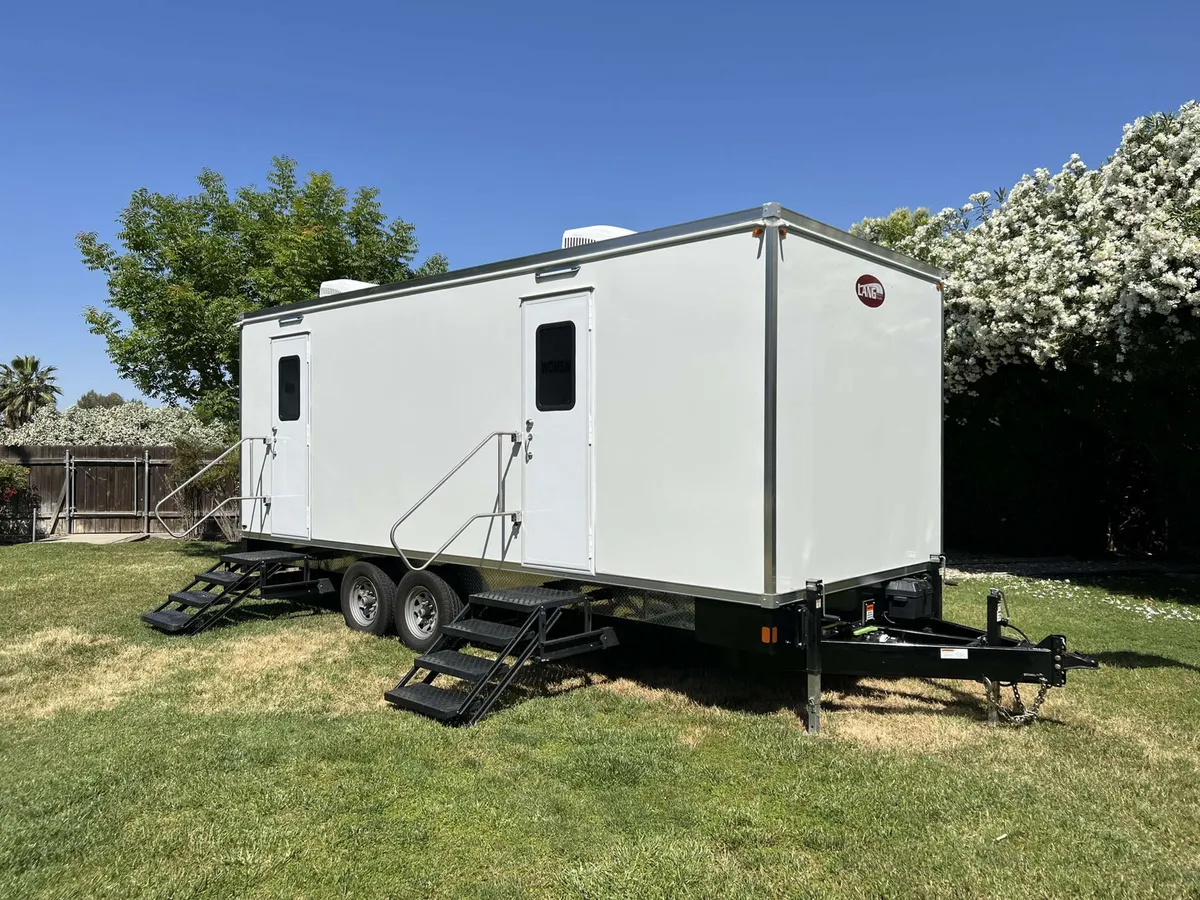
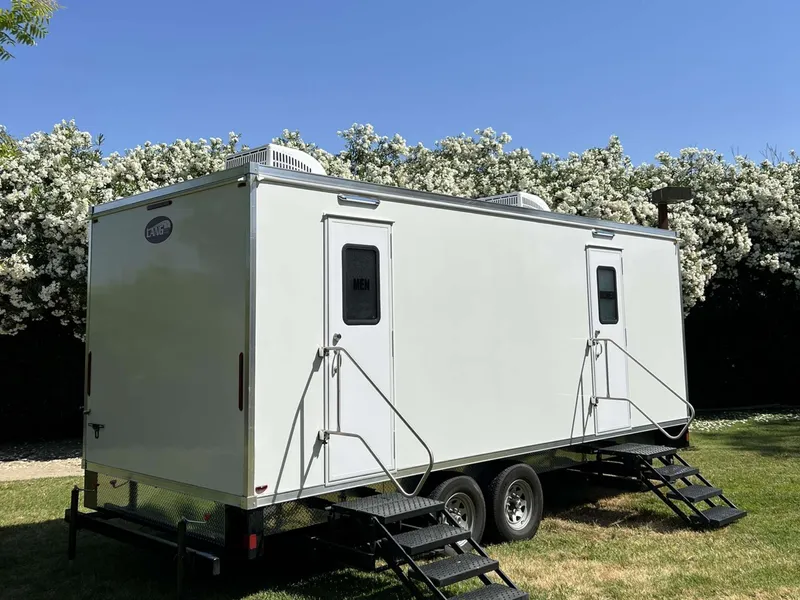
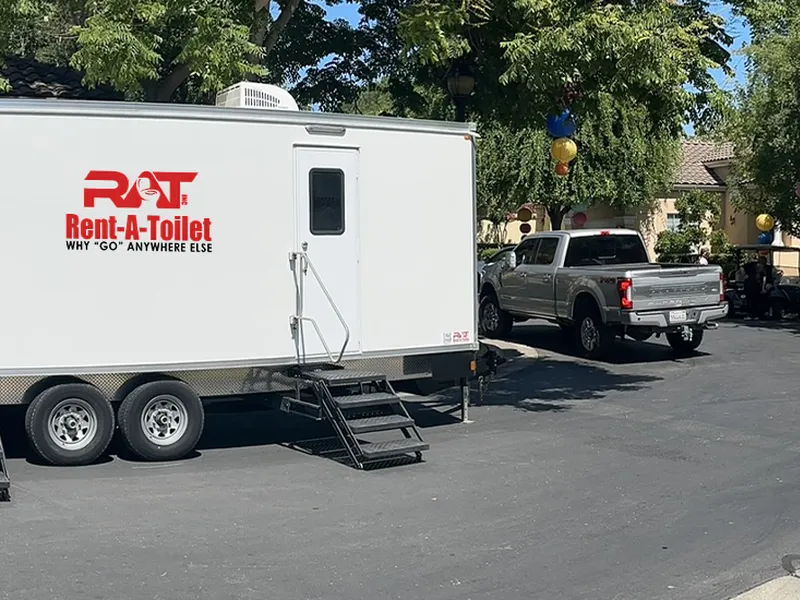
| Stations | Women's 5, men's 4 (one is a waterless urinal) |
|---|---|
| Box size | 21 ft long, 101 in wide |
| Length with tongue | 26 ft 4 in |
| Width with stairs | 12 ft 4 in |
| Height with A/C | 11 ft 10 in |
| Fresh water tank | 200 gal (optional package) |
| Waste tank | About 750 gal |
| Climate | Two 13,500 BTU A/C units, two 5,000 BTU heat strips |
| Power | Two 120 V, 20 amp circuits |
Sizes are the maker's published figures for this trailer. Call and the yard confirms anything else on the phone.
Inside the Unit
Five stations on the women's side, four on the men's, and a mechanical room behind its own door carrying the water and the pumps.
A bank of private stalls
Stalls plus urinals
Behind its own door
We would rather size it with you than print a guest number that is wrong for your night. Give us the headcount, the hours, and whether there is a bar, and we will tell you whether this plan carries it on its own or wants standard units alongside.
Before You Book
Ask this early. Nine stations is the plan most likely to be ruled out by the ground rather than by the guest list, and people usually find that out on the day instead of on the call.
It needs power for the lights, the water pump and the air conditioning. Tell us where the trailer will sit and how far the nearest outlet is. If there is nothing close, we settle the generator question before you book.
The trailer carries its own fresh water and holds what it uses in a waste tank, so a wall spigot is not required. A hose hookup extends how long it runs before a service stop. For a long day or a big crowd we schedule that stop in advance.
It is towed in behind a truck, so it needs a route wide enough to get in and turn around, and reasonably level ground to sit on. Grass, gravel and asphalt all work. We walk the placement with you before delivery rather than after.
These stand tall with the air conditioner on the roof, so a low carport or a garage is out. Flag gates, wires and low branches when you call and we will pick the approach in.
Sizes are the maker's published figures for this trailer. Call and the yard confirms anything else on the phone.
There are only so many of these. Give us the date, the headcount and the address.
Where This One Fits
Two very different customers rent this one, and they want opposite things from it.
Hundreds of people, one afternoon.
Nine doors, a service stop planned around the schedule, and standard units set further out so the walk is short from every part of the site.
Fifty people, every day, for months.
Long-term rental on a weekly route with the cadence set to the headcount. Construction is what this company does most of, and the trailer rides the same schedule as the restrooms.
Nothing to plug into.
It carries its own water. Power is the question, and we answer it before you book rather than at the gate on the morning.
A crew that walks off over the bathrooms costs more than the bathrooms ever did.
Straight Answers
Every question below is one a real person asked in public. We do not invent them.
Because that is what the standard rental covers, not because that is all anybody will do. A weekly or twice-weekly route is what the price is built around. If your headcount is higher than the route assumes, buy more service rather than living with it. Tell us the crew size at the start and we will put the right cadence on the contract instead of you finding out in month two.
This is a fair thing to pin down in writing before you sign anything, with anybody. Ask the question exactly the way you would ask it if you were going to be annoyed about it later: how many service visits are in the price, does delivery count as one of them, and what does an extra visit cost. Get the answer on the paperwork. We would rather have that conversation on day one than in a review.
Call the yard that delivered it, not a call center. Every unit we set is dispatched from one of three yards and the number on the unit reaches the people who load the truck. A missed pickup is a scheduling failure and it gets fixed by the person who owns the schedule. That is the practical reason to rent from a company with its own trucks.
We will tell you whether nine stations is the right call, or whether a smaller trailer with standard units alongside gets you there instead.
Nearby
Nine stations is the top of what we run. Most events do not need it, and we will say so.
Six doors, a shorter deck and an easier turn into most sites.
An accessible station, which a public event usually needs by rule.
Set alongside a trailer, they shorten the line for a fraction of the cost.
The parent page, with the three tiers and a walkthrough video.
On a big site the answer is usually a trailer plus units, not the biggest trailer. Give us the layout and we will tell you where to put what.
Nine stations is festival and fairground territory. See festivals and concerts, the smaller three station plan, or the full rental list.