

Servicing
It is the part of this business nobody explains, and the part everyone quietly wonders about. Here is the whole sequence, from the truck pulling up to where it ends.
The Service Visit
One customer asked this out loud and nobody answered them, so here it is in order.
“Nobody talks about how do you clean the waste out and dump? How do you clean”Comment on a portable toilet video, 2025
A vacuum truck pulls up. The tank on the truck holds a vacuum, and a hose goes down into the holding tank in the unit and pulls everything out of it. That takes a couple of minutes per unit.
Then the unit gets washed down, inside surfaces first, and a fresh charge of deodorizer goes into the empty tank. Paper and hand sanitizer are restocked. The door is closed and the truck moves to the next stop on the route. Nothing is emptied on your ground and nothing is left standing.
Not into a storm drain, not onto a field, and not into a septic tank. Portable toilet waste is regulated septage, and it goes to a permitted receiving facility that is licensed to take it. The load is logged.
If your job needs disposal documented, and some public and agricultural contracts do, ask for it when you book rather than after the fact, and we will tell you what we can provide.
Our crew does, on the service visit. The unit leaves the yard clean and stocked, and both go back in every time it is serviced. It is not a separate call you have to remember to make.
A busy site can still run dry between visits. That is a real complaint people make about this industry and it is fair. If it happens, call the yard instead of waiting for the next scheduled stop, and it is worth keeping a spare roll or two in the job trailer for the gap.
Where It Ends Up
Everything in this job comes back to a tank and a licensed place to empty it. That is the whole chain: the unit holds it, the vacuum truck takes it, and it goes to a permitted facility that is allowed to receive it. There is no step in there you are meant to do yourself.
On sites that generate more than a unit can hold, the answer is usually a holding tank pumped on a schedule rather than more units, and where there is already a tank or a system in the ground we handle that side too under septic pumping. A rented portable restroom is serviced by us, always.
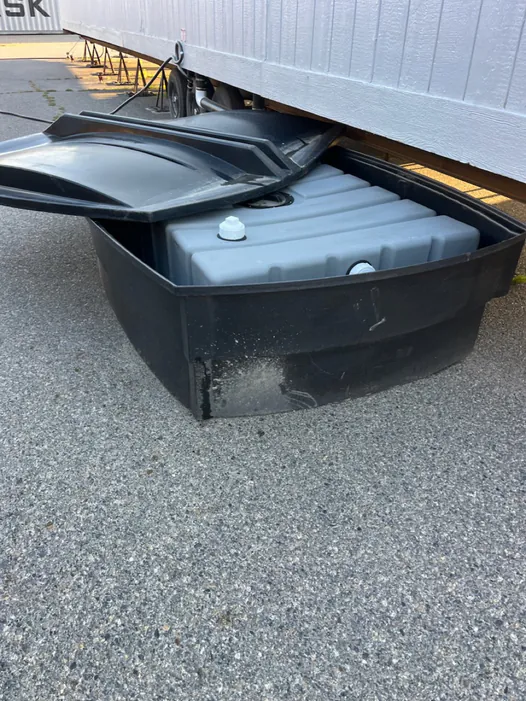 A holding tank with the lid up
Call the yard nearest the job. That is what the number is for.
The Schedule Argument
This is the single term that arguments start over, and it costs nothing to settle before the unit ships. Ask for it in writing on the quote: how many service visits the rental carries, which day of the week they land, and whether the drop-off counts as the first one.
What sets the schedule is load rather than the calendar. A full crew on a five-day week works a unit harder than two people on weekends, and the interval should be built to that.
Yes. Call the yard nearest the job. A unit that has gone bad early is usually telling you the interval was set for a smaller crew than the one that turned up, and the fix is to change the schedule rather than to keep calling in extras.
Ask what an extra visit costs at the time you book, so the answer is already on the table the day you need it rather than being negotiated while a crew is standing there.
One Thing To Be Clear About
No. If you are renting from us, the waste is ours to handle and the disposal is ours to answer for. There is no version of this where you are better off doing it yourself, and depending on where it ends up there is a version where you are the one who gets fined.
This page used to be written the other way round, as a guide to doing it yourself. That was never the right advice for someone renting a unit, so it has been rewritten as what actually happens when we service it. If a unit is a problem, the answer is a phone call.
See also the questions we get on the phone and portable restroom rental.
What the law asks of you, and the unit that changes the service interval.
Who has to provide them, which California standard applies, and what hand washing requires.
The middle rung between a standard unit and a bathroom trailer, and what it asks of your site.
Eleven pieces on sizing, placement, servicing, permits and cost.
Headcount, dates, and the city. That sets the service schedule.